Global Clean Energy Intelligence Edition
GCES PORTAL
Global Clean Energy Systems Intelligence
When does refrigerated storage make sense for green ammonia?
A project can have an efficient green ammonia production plant and still struggle with storage. A delayed vessel, a week of strong renewable generation, or an interrupted customer delivery can turn a nominal buffer into a constraint on the entire operation.
For project managers developing green ammonia infrastructure, refrigerated storage becomes a serious option when inventory volumes, shipping schedules, and site conditions justify its complexity. Keeping ammonia near its atmospheric boiling point of approximately −33°C reduces pressure-containment requirements, but introduces refrigeration, boil-off management, and demanding safety provisions. The decision is not simply about tank size: it is about how the storage system behaves during normal operation, disruption, and recovery.
The strongest case starts with the inventory profile
Fully refrigerated storage is generally most attractive where a project must hold substantial quantities of ammonia in a central location. Export terminals, import hubs, and production sites serving large, intermittent shipments are natural candidates. At these scales, low-pressure tank construction can offer a stronger economic case than storing the same inventory across multiple pressure vessels.
There is no universal capacity threshold at which refrigeration becomes the correct answer. Local construction costs, available land, design requirements, utility infrastructure, and delivery conditions can move the crossover considerably. A capacity rule of thumb is useful for screening, not for approving investment.
Before comparing technologies, develop a time-based inventory model. It should include:
- Production rates under expected renewable electricity and plant operating schedules.
- Shipment parcel sizes, loading rates, and credible vessel delays.
- Customer withdrawal patterns and minimum delivery commitments.
- Usable working inventory after minimum operating levels, filling limits, and maintenance constraints.
- Recovery after an outage, including the risk of production and shipping restarting at different times.
The important distinction is between annual throughput and peak inventory. Two projects moving the same annual tonnage may need very different storage systems: one dispatches continuously, while the other accumulates product for occasional shiploads. Storage selection should follow that operating reality rather than the production plant’s nameplate capacity.
What changes between pressurized, semi-refrigerated, and refrigerated storage?
Green ammonia has the same relevant storage properties as conventionally produced anhydrous ammonia of equivalent composition. Its production pathway does not remove toxicity, materials compatibility requirements, or the need to control pressure and temperature.
These are screening categories, not interchangeable equipment packages. In particular, “near atmospheric” does not mean an open tank or an unpressurized system without protective controls. Fully refrigerated tanks have defined pressure and vacuum limits, and comparatively small deviations can matter.
For green ammonia, shipping and power must be assessed together
Consider a proposed export project that produces ammonia throughout the month but loads vessels in discrete parcels. Refrigerated storage can provide the necessary accumulation capacity and match a refrigerated shipping chain. The case strengthens when incoming product already arrives cold, reducing the cooling needed at the storage boundary.
Now consider a smaller inland installation supplying nearby industrial users by regular road deliveries. If product arrives under pressure at ambient temperature, refrigerated storage introduces cooling equipment and transfer interfaces that may deliver little value at that scale.
Neither example establishes a fixed rule. The useful question is: does the storage condition simplify the complete logistics chain, or merely shift cost and complexity elsewhere?
Map ammonia temperature, pressure, and flow across production, storage, loading, transport, and customer receipt. Include vapor return arrangements and the treatment of displaced vapor. A tank that looks economical in isolation can become expensive once product cooling, export pumping, receiving-site requirements, and loading restrictions are included.
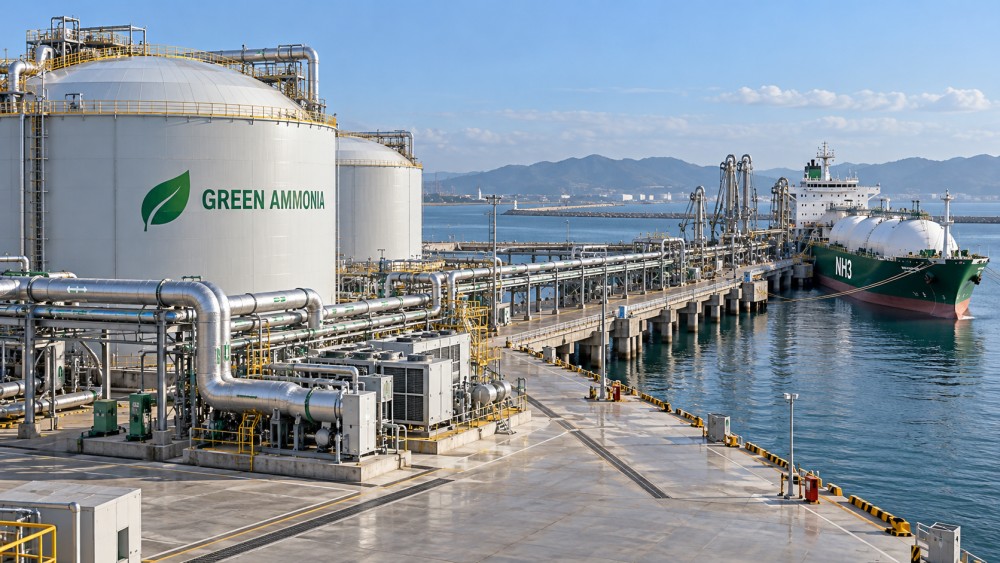
Renewable power variability adds another interface. If ammonia production is flexible, storage may need to absorb uneven output. However, reduced production does not eliminate refrigeration requirements: ambient heat continues entering the tank, and some essential services must remain available even when the production plant is offline.
Refrigeration is a continuous obligation, not just an electricity allowance
A refrigerated tank gains heat through its insulation, foundation, penetrations, and connected systems. Transfers can add further vapor loads. The refrigeration or reliquefaction system must handle the relevant operating cases, not just the steady-state heat leak quoted for an undisturbed tank.
Require the process design to distinguish routine heat ingress from loading, unloading, cooldown, and upset conditions. Incoming product temperature and pressure are especially important: pressure reduction or warm receipts can generate flash vapor that exceeds the normal holding load.
Ask suppliers to state the assumptions behind refrigeration capacity and energy consumption. A single power figure is not decision-ready unless it identifies ambient conditions, tank inventory, receipt conditions, equipment availability, and system boundaries.
Test the loss-of-power scenario before selecting the tank
Refrigerated storage needs a defined response to utility failure. The engineering team should calculate pressure rise under credible conditions, identify the time available for intervention, and establish which protective functions remain operational.
That does not automatically mean providing standby generation for every refrigeration compressor. Depending on the design and risk assessment, the solution may combine equipment redundancy, an independent power source, controlled operating restrictions, and other engineered measures. Instrumentation, detection, isolation, and essential controls also require appropriate power resilience.
Pressure-relief devices remain necessary protection, but routine venting of ammonia is not an acceptable substitute for a vapor-management strategy. Any emergency discharge or treatment arrangement must be assessed for its consequences and compliance with local requirements.
Low pressure does not mean low consequence
Reducing storage pressure changes the containment problem; it does not remove the ammonia hazard. A large refrigerated inventory still demands rigorous assessment of toxic releases, low-temperature exposure, tank integrity, and emergency access.
Cold ammonia releases can form aerosols and initially behave differently from warm ammonia vapor. Dispersion assessments should therefore represent the release conditions, weather, terrain, and nearby receptors rather than assume every release immediately rises and disperses safely.
Containment configuration matters as much as storage temperature. Single, double, and full containment arrangements have different functions and failure responses; terminology and requirements must be checked against the applicable design framework. The selected arrangement should be justified through hazard studies, site conditions, and permitting requirements—not copied from another terminal.
- Materials and construction: Specify materials, welding procedures, and inspection appropriate to low-temperature service and ammonia compatibility.
- Foundation protection: Evaluate ground freezing, frost heave, insulation performance, and foundation heating where required.
- Release management: Assess impoundment, drainage, detection, isolation, and the consequences of mitigation measures.
- Operating readiness: Plan training, controlled access, emergency coordination, and realistic response exercises before first fill.
Land availability should be assessed through an actual layout and consequence study. A compact-looking tank does not necessarily produce a compact site once separation distances, transfer equipment, containment, maintenance access, and neighboring activities are considered.
Compare lifetime cost on equal terms
The refrigerated option may win on bulk containment economics while losing on site infrastructure—or the reverse. Comparing a tank quotation with a complete pressurized installation will not reveal which system is better.
Use the same operating scenarios and battery limits for every option. Capital estimates should cover storage containment, foundations, refrigeration, pumps, piping, electrical supply, controls, safety systems, civil works, and logistics interfaces. Include commissioning and initial cooldown, not just equipment delivery.
Operating costs extend beyond electricity. Maintenance, inspections, specialist support, spare parts, staffing, and eventual decommissioning all deserve attention. For large custom-built tanks, construction quality and repair access can influence lifetime exposure as strongly as initial equipment pricing.
Also price the operational consequences of failure. If a refrigeration outage forces production curtailment or a missed vessel slot, the commercial impact may exceed the energy savings being debated during procurement. Conversely, building excessive inventory for an unlikely disruption can tie up capital without a proportionate resilience benefit.
Useful sensitivities include electricity prices, ambient conditions, shipment delays, lower-than-planned throughput, and phased production growth. Test the early operating years separately: a terminal designed for future expansion may carry substantial fixed costs while using only part of its storage capacity.
What should be resolved before equipment procurement?
A credible selection package should let reviewers trace the recommendation from operating assumptions to equipment requirements. It should also distinguish confirmed infrastructure from anticipated connections, proposed shipping arrangements, and future offtake.
- Freeze the design basis: Record product specification, receipt conditions, inventory range, transfer rates, and operating modes.
- Compare complete alternatives: Retain pressurized and semi-refrigerated options long enough to establish a defensible lifecycle comparison.
- Validate abnormal operation: Assess power loss, refrigeration unavailability, interrupted loading, delayed shipping, and restart sequences.
- Confirm the approval pathway: Identify applicable tank, pressure-equipment, environmental, occupational safety, and port requirements by jurisdiction and current edition.
- Check deliverability: Verify specialist contractor availability, low-temperature materials procurement, inspection capacity, construction schedule, and commissioning responsibilities.
Evidence deserves the same scrutiny as technical calculations. An announced terminal is not an operating reference. When reviewing comparable projects, establish whether the relevant storage system is proposed, contracted, under construction, commissioned, or operating under representative conditions.
The decision is about useful inventory, not the largest tank
Refrigerated storage makes the strongest case when substantial working inventory, bulk logistics, and compatible product conditions outweigh the added refrigeration and safety obligations. It is particularly compelling when pressure-vessel alternatives become cumbersome and the site can support reliable utilities, specialist construction, and disciplined operations.
Pressurized storage can remain the better choice for smaller or distributed duties, especially where it matches receipt and delivery conditions. Semi-refrigerated storage deserves consideration where an intermediate pressure-temperature balance improves the overall system.
For project managers, the decisive test is straightforward: does the selected arrangement keep green ammonia moving safely and economically through the project’s real operating cycle—including the difficult days? Validate that cycle before committing to a tank specification. Capacity follows from the logistics; temperature and pressure should follow from the whole-project comparison.
Related News