Global Clean Energy Intelligence Edition
GCES PORTAL
Global Clean Energy Systems Intelligence
How much treated water does green hydrogen production require?
How much treated water does green hydrogen production require?
How much treated water should a Green Hydrogen project budget for—and where should engineers draw the system boundary? Electrolysis consumes a theoretical minimum of about 9 litres of water per kilogram of hydrogen, but practical demand depends on feedwater quality, purification losses, cooling design, and operating conditions. For project managers, distinguishing electrolyser-grade water from total site withdrawals is essential to sizing treatment systems, securing supply agreements, and assessing costs.
The useful answer is therefore not one universal litres-per-kilogram figure. It is a water balance with defined boundaries: how much purified water reaches the hydrogen production package, how much source water the treatment plant needs, and what the rest of the site consumes. Those quantities serve different engineering and commercial decisions.
Start with 9 litres—but do not use it as the purchase specification
The electrolysis reaction splits water into hydrogen and oxygen. From the molecular mass balance, producing one kilogram of hydrogen consumes approximately nine kilograms of water, equivalent to roughly nine litres under ordinary conditions. This is the chemical requirement, not a guaranteed operating-water requirement for a complete installation.
Actual purified-water makeup may also cover water leaving with gas streams, purges, sampling, maintenance, or other package-specific operations. Internal separation and recovery arrangements affect how much of that water returns to the process. The supplier’s stated consumption must therefore identify whether it describes the stack, the complete electrolyser package, or a wider hydrogen production system.
Ask for a guaranteed makeup-water requirement at the agreed delivery point, with its operating conditions. A nominal figure without pressure, load, ambient conditions, and recovery assumptions is difficult to use in a performance test—and risky to use for utility sizing.
Separate three water quantities before comparing proposals
“Treated water” can mean filtered municipal water, reverse-osmosis permeate, or polished water meeting the electrolyser manufacturer’s specification. These are not interchangeable. A shared vocabulary prevents the treatment contractor and electrolyser supplier from pricing different interfaces.
Withdrawal also differs from consumption. Some withdrawn water may leave as a permitted liquid discharge rather than being consumed. That distinction matters in environmental reporting, but discharged water still needs intake capacity, treatment, and a lawful disposal route.
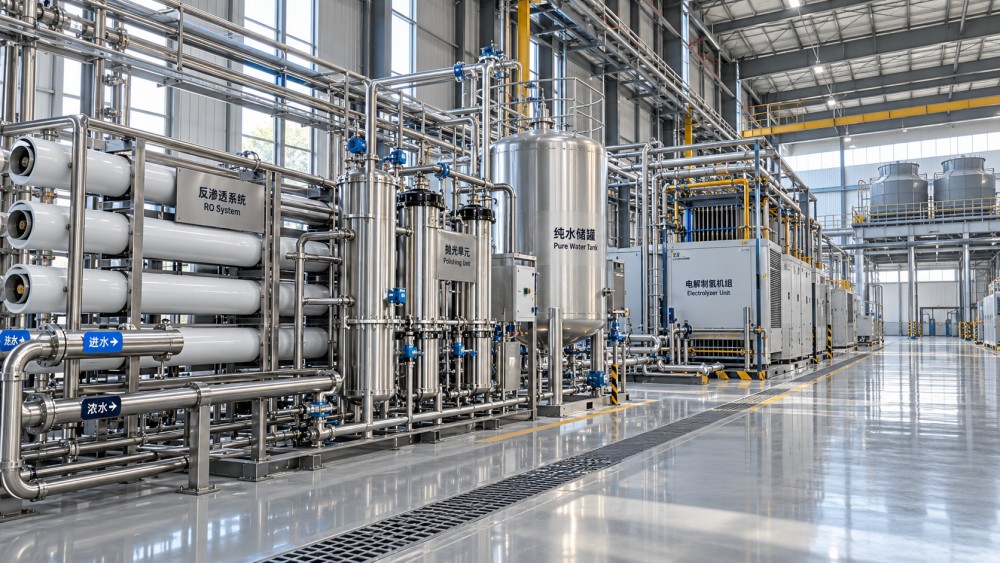
A useful process diagram shows source water entering pretreatment and purification, with separate branches for reject water, electrolyser makeup, cooling makeup, and recoverable streams. Mark quality requirements and flow-meter locations at the interfaces.
Translate treatment recovery into a defensible flow requirement
For a defined treatment boundary, the basic calculation is:
Source-water feed = required product-water flow ÷ overall treatment recovery.
Consider an illustrative design producing 1,000 kg of hydrogen per hour. Assume—not as an industry benchmark, but as a calculation input—that the electrolyser package requires 10 litres of purified makeup per kilogram. Product-water demand is then 10 m³/h. At an assumed overall treatment recovery of 75%, source-water feed would be approximately 13.3 m³/h, before cooling or other independent users are added.
The difference, approximately 3.3 m³/h, represents water not delivered as product within that assumed treatment boundary. Its actual destinations depend on the process: membrane concentrate, filter backwash, cleaning, or other losses. A membrane’s stated recovery alone may not represent the whole plant’s recovery.
Use consistent boundaries when combining pretreatment, reverse osmosis, and polishing. Internal recycle can reduce fresh-water demand, but it can also concentrate contaminants. Credit recycled water only after confirming its quality, destination, and effect on the complete mass balance.
For annual demand, integrate production and water use across the operating schedule. Multiplying nameplate hourly demand by every hour of the year can misrepresent a renewable-powered plant. Conversely, an annual average is not an adequate basis for sizing a treatment plant that must support sustained high-load operation.
Water quality determines which treatment train is credible
Municipal supply, groundwater, reclaimed wastewater, and seawater require different treatment designs. Even an apparently reliable supply can vary seasonally in temperature, dissolved salts, organics, or suspended solids. A single favourable sample is a weak basis for a long-term process guarantee.
Obtain the electrolyser supplier’s written feedwater specification rather than relying on a generic “deionised water” description. Requirements can address conductivity and specific contaminants, as well as sampling conditions and measurement methods. Low conductivity alone does not establish that every relevant contaminant is controlled.
For reclaimed water, variability and organic contamination may influence pretreatment and monitoring. For seawater, desalination adds a treatment stage and a concentrate-management obligation. Neither source removes the need to meet the final electrolyser specification. A proposed direct-seawater demonstration should not be treated as equivalent to an operating, warranted utility system.
Storage and distribution deserve attention too. Water that meets specification at the polishing outlet may deteriorate before reaching the electrolyser. Tank materials, pipework, circulation, and sampling locations belong in the quality-control scope—not between two contractors’ exclusions.
Cooling can change the site balance more than the reaction does
Electrolysis equipment rejects heat. Whether that heat is removed through dry cooling, evaporative cooling, or a hybrid arrangement changes external water demand. A closed process-cooling loop does not necessarily mean a water-free site: the equipment rejecting heat from that loop may still consume water.
With an evaporative cooling system, makeup must cover evaporation, blowdown, and other losses. Its requirement depends on heat duty, climate, and allowable concentration of dissolved constituents. Do not add a generic cooling allowance to every hydrogen project and assume the result is conservative.
Dry cooling reduces the need for evaporative makeup, but its selection must account for hot-weather performance, auxiliary electricity, equipment footprint, and temperature limits. Compare the alternatives at the project’s design ambient conditions, not just at an attractive annual average.
Extend the boundary deliberately if hydrogen feeds another process. Compression, green ammonia production, or synthetic-fuel facilities may introduce additional cooling and utility loads. Report those separately so an integrated fuels project is not compared with a standalone electrolyser on mismatched terms.
Specify peak duty, interruptions, and responsibility before procurement
A renewable-linked electrolyser and its water treatment plant do not have to follow identical operating profiles. Product-water storage can allow treatment to run more steadily while hydrogen output varies. But a tank needs a defined purpose: balancing production, bridging a treatment outage, or supporting an orderly shutdown.
Size usable storage against the required makeup rate and a justified interruption duration. Account for unusable tank volume and water-quality constraints. Firewater reserves and other emergency duties should remain separately identified unless the design and applicable requirements explicitly permit shared provision.
Before purchase orders are placed, resolve these interface questions:
- Who guarantees water quality at the electrolyser inlet, including after storage?
- What flow is required during rated operation, startup, shutdown, and maintenance?
- What happens when conductivity or another quality parameter exceeds its limit?
- Can treatment continue during equipment maintenance, and what outage can storage bridge?
- Who owns reject-water treatment, discharge approvals, and performance testing?
Off-specification water should trigger a defined response, such as diversion or an operating interlock agreed with the equipment supplier. Sending questionable water forward to preserve short-term production can expose the project to equipment damage and warranty disputes.
Budget the water system, not just the water tariff
The raw-water bill is only one cost line. Treatment electricity, chemicals, replacement membranes or polishing media, laboratory testing, staffing, storage, and reject disposal can all affect lifetime economics. A cheap source with difficult contaminants or an expensive discharge route may not be the lower-cost option.
Supply security also has a commercial value. Check whether the contracted volume remains available during dry periods and whether abstraction restrictions can coincide with strong renewable generation. Any tariff, permit condition, or reuse requirement should carry its jurisdiction and effective date; it should not be transferred casually between markets.
This connected-system perspective is central to the planned GCES international B2B information portal, covering renewable generation, storage, grid infrastructure, hydrogen, and green fuels. Useful project comparisons need to distinguish proposed designs, awarded contracts, demonstrations, and operating assets—and identify whether reported water figures are design estimates or measured performance.
For a procurement-ready Green Hydrogen project, retain the roughly 9 L/kg chemical minimum as a reference, not a site guarantee. Require an agreed water balance showing electrolyser makeup, treatment recovery, cooling demand, peak flows, and discharge streams. Once those boundaries are signed off, treatment capacity and supply commitments become quantities the project can defend.
Related News
 Electrolytic HydrogenWhat limits the minimum operating load of alkaline electrolyzers?Alkaline Electrolyzers face minimum-load limits driven by gas crossover, purity, and safety. Discover how to assess supplier claims and improve renewable-powered operation.MORE+
 Electrolytic HydrogenHow much treated water does green hydrogen production require?Green Hydrogen needs about 9 litres of water per kg at minimum—but site demand varies. Learn how treatment losses and cooling affect water budgets and smarter project planning.MORE+