Global Clean Energy Intelligence Edition
GCES PORTAL
Global Clean Energy Systems Intelligence
What limits the minimum operating load of alkaline electrolyzers?
The minimum operating load of alkaline electrolyzers is usually constrained by gas purity and safety before the stack loses its ability to split water. As current falls, hydrogen and oxygen production decrease, but gas crossover does not necessarily decrease proportionally. Contamination can therefore approach the system’s protective limits. Pressure, temperature, separator condition, electrolyte circulation, and control response determine where that boundary lies; there is no universal minimum-load percentage.
For a renewable-powered installation, this distinction matters when available power falls toward the supplier’s stated turndown limit. The plant may continue producing, reduce pressure, isolate individual modules, or enter standby. Each response changes hydrogen delivery and auxiliary consumption. A useful evaluation must establish whether the quoted minimum describes a warm stack under steady conditions or the complete plant following a fluctuating power input.
The central constraint: crossover relative to gas production
An alkaline cell uses an electrolyte-wetted separator to provide ionic conduction while limiting mixing between the hydrogen and oxygen compartments. The barrier is not perfectly impermeable. Dissolved gases can pass through it, and gas transport can also occur through electrolyte circulation paths, depending on the hydraulic design. Separator defects or excessive differential pressure can introduce additional crossover mechanisms.
Useful gas production broadly follows current through Faraday’s law. Crossover, however, also depends on gas partial pressures, dissolved-gas concentrations, temperature, separator properties, and circulation. At low current, a continuing crossover flow is diluted by less product gas. Hydrogen concentration in the oxygen stream can consequently rise even while total hydrogen production falls.
A simplified relationship illustrates the issue:
Hydrogen fraction in oxygen ≈ hydrogen entering the oxygen stream ÷ total gas flow leaving the oxygen side.
This is a screening relationship, not a design calculation. A complete balance must account for both gases, dissolved inventories, water vapor, sampling conditions, and transient accumulation. It nevertheless explains why reducing electrical input does not automatically reduce the gas-mixing hazard.
The oxygen stream is often especially important because electrolysis produces less oxygen than hydrogen on a molar basis, although crossover rates need not be equal in both directions. Both product streams require assessment. Hydrogen purity may also become unacceptable for downstream equipment before the electrolyzer reaches its own safety limit.
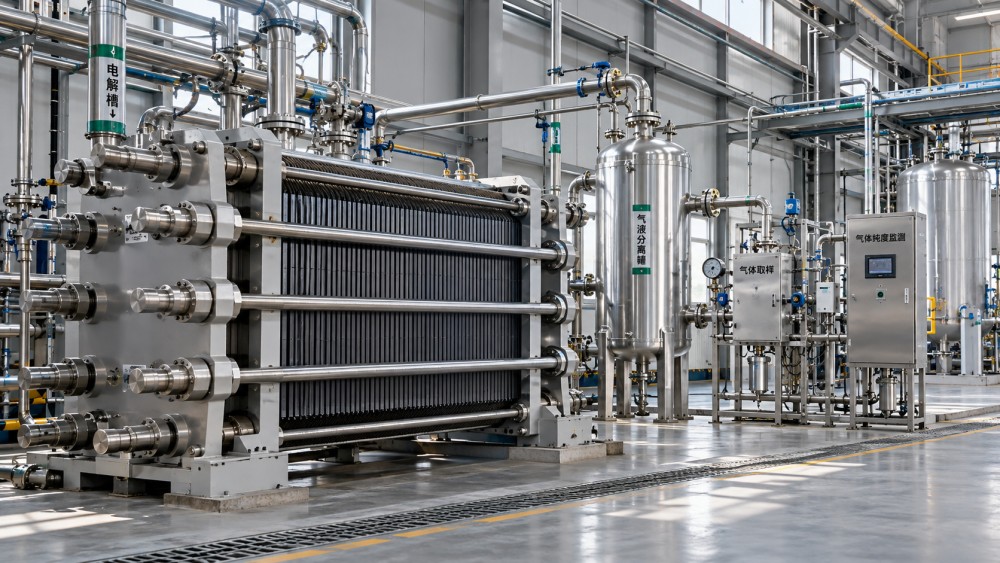
Pressure and separator behavior reshape the operating window
Two pressure effects should be evaluated separately. Absolute pressure influences gas dissolution and transport. Differential pressure across the separator can drive liquid movement and, if the separator’s gas-entry resistance is exceeded, gas penetration. Balanced anode and cathode pressures therefore do not eliminate crossover; they address only part of the problem.
Pressurized operation can increase dissolved-gas inventories and crossover under otherwise comparable conditions. A minimum load demonstrated near atmospheric pressure should not be assumed valid at the project’s delivery pressure. Conversely, lowering pressure may extend turndown, but only if the system is designed and validated for that operating mode. Pressure changes also affect downstream compression and gas handling.
Separator thickness, pore structure, wettability, permeability, and mechanical condition influence the compromise between electrical resistance and gas separation. A low-load result from a new stack does not establish the same margin throughout its service life. Evaluation should address separator aging and allowable pressure imbalance, rather than treating the separator specification as a permanent guarantee.
Temperature, circulation, and auxiliaries can become binding limits
Low current reduces internal heat generation. During an extended low-power period, stack temperature can drift away from the condition used to establish the supplier’s performance claim. Lower temperature generally increases electrical losses and changes gas solubility, diffusion, and release behavior. The net effect on crossover is design-specific; temperature alone is not a reliable indicator of safe turndown.
The relevant question is whether thermal management can maintain the validated operating envelope. A plant might need external heating to remain ready, or it may tolerate cooling and accept a restricted restart sequence. A short low-load demonstration on an already hot stack does not prove continuous operation through a prolonged renewable-power lull.
Electrolyte circulation must still support temperature control, bubble removal, and stable liquid levels. Depending on circuit architecture, excessive circulation may transport more dissolved gas between sections, while insufficient circulation can impair heat removal or gas disengagement. Adjusting flow is therefore a system-design measure, not a generic instruction to reduce pump speed.
Fixed auxiliary loads create a separate limitation. Pumps, controls, cooling equipment, heaters, and gas treatment can consume a substantial share of input power when stack power is low. This may establish an economic or net-production floor above the safety floor. Downstream purification or compression may also have minimum-flow requirements that restrict usable plant output.
Steady operation is not the same as following a power ramp
A stack may remain within purity limits at a stable low current yet exceed them during a transition. Gas separators, electrolyte loops, and sampling systems contain inventories that respond more slowly than electrical current. Following a rapid power reduction, gas production falls immediately while dissolved-gas release and crossover can persist.
Pressure and liquid-level controls can introduce further delays. Temporary pressure imbalance during a ramp may create a different crossover condition from the one measured after stabilization. Restart after standby brings another set of conditions: residual gases, temperature recovery, pressure equalization, and the routing of initial product all affect whether gas is suitable for delivery.
Gas-analyzer response is part of this dynamic assessment. Sample-line volume, conditioning equipment, sample flow, analyzer response, and control-system processing all contribute to detection delay. At low process flow, the sampled concentration may not represent the stack’s current condition quickly enough unless the measurement arrangement is designed for that regime.
Useful validation should therefore include sustained low-load operation, downward ramps, repeated fluctuations, and restart transitions. Recorded variables should include current density, temperature, both side pressures, differential pressure, electrolyte flow, and gas composition on a common time basis. Stabilized purity readings alone cannot establish dynamic safety.
Separate the safety threshold from the operating guarantee
A flammability boundary is not an acceptable normal operating target. Protective limits require margin for measurement uncertainty, response delay, process variation, and credible faults. Gas-mixture behavior also depends on conditions such as pressure, temperature, and water-vapor content. A generic concentration value should not be adopted as a universal trip setting.
For each gas measurement, establish whether the reported concentration is on a wet or dry basis, where the sample is taken, and what happens when the analyzer is unavailable. An analyzer downstream of gas treatment may demonstrate delivered-product quality without independently establishing the composition inside the electrolyzer’s process equipment.
Project requirements may reference ISO 22734 for water-electrolysis hydrogen generators, alongside applicable pressure-equipment, electrical, and hazardous-area requirements. The applicable edition, jurisdiction, and equipment scope need confirmation. A standards-compliance claim does not by itself establish a specific turndown ratio; that requires design-specific operating limits and supporting evidence.
The operating documentation should distinguish normal control limits, alarms, protective trips, and restart permissives. Any proposed change to those boundaries belongs within the manufacturer’s engineering and safety-management process—not an on-site attempt to obtain a lower minimum load.
Translate supplier percentages into comparable quantities
“Minimum load” can refer to stack current, stack DC power, total plant AC input, or hydrogen production. These are not interchangeable. Stack voltage varies with current and temperature, auxiliaries do not scale directly with output, and off-specification gas may be diverted rather than delivered. A low electrical-input claim can therefore overstate usable production flexibility.
Ask suppliers to express the guarantee in both current density and clearly defined plant-level quantities. The operating conditions should include pressure, temperature range, duration, purity requirements, auxiliary demand, and whether hydrogen remains available at the delivery boundary.
Modular operation introduces another distinction. A plant can sometimes reduce total output by shutting down selected modules while keeping the remaining modules above their individual minimum loads. That extends plant-level turndown without demonstrating deeper stack-level turndown. Shared gas headers, purification equipment, and compressors may still limit this approach.
- Define the boundary: specify gross stack production or net delivered hydrogen, and identify which auxiliaries are included.
- Match operating conditions: require evidence at the intended pressure and thermal state, including the duration of low-load periods.
- Identify the binding constraint: distinguish gas safety, product quality, thermal stability, hydraulic control, and downstream equipment limits.
- Verify transitions: establish allowable ramp rates, standby entry conditions, restart requirements, and handling of off-specification gas.
- Document lifetime assumptions: clarify how aging, maintenance condition, and instrument uncertainty affect the guaranteed envelope.
Choose the response to low power from the validated envelope
For a variable-power project, the practical decision is what the plant should do when available power approaches its continuous operating floor. Continuing operation is appropriate only while gas composition, pressure control, and thermal conditions remain within the validated envelope. Reducing pressure may help some designs, but it must be an approved mode with defined consequences for delivery pressure and downstream equipment.
Where modular isolation is available, dispatch can keep active stacks within their permitted range. Where brief power dips dominate, electrical buffering may reduce transitions, provided its usable energy and control response match the dips being addressed. Neither measure changes the intrinsic crossover limit of an individual operating stack.
For longer low-power periods, controlled standby or shutdown may be preferable to holding the plant just above its trip boundary. The comparison should include auxiliary energy, purging or venting losses, restart time, off-specification production, and cycling restrictions. The strongest minimum-load guarantee is therefore not the lowest percentage: it is a defined operating envelope supported by purity measurements, transient validation, and an explicit response when available power falls below it.
Related News
 Electrolytic HydrogenWhat limits the minimum operating load of alkaline electrolyzers?Alkaline Electrolyzers face minimum-load limits driven by gas crossover, purity, and safety. Discover how to assess supplier claims and improve renewable-powered operation.MORE+
 Electrolytic HydrogenHow much treated water does green hydrogen production require?Green Hydrogen needs about 9 litres of water per kg at minimum—but site demand varies. Learn how treatment losses and cooling affect water budgets and smarter project planning.MORE+