Global Clean Energy Intelligence Edition
GCES PORTAL
Global Clean Energy Systems Intelligence
Can an Alkaline Electrolyzer Run Economically on Intermittent Solar?
Yes—an alkaline electrolyzer can run economically on intermittent solar power, but cheap solar electricity alone does not establish a viable hydrogen project. The decisive question is whether electricity savings outweigh lower equipment utilization, variable-load losses, restart requirements, and the cost of delivering hydrogen when it is needed.
A technically workable solar-only plant can still produce expensive hydrogen. Conversely, an alkaline system with a verified operating envelope, well-matched solar capacity, and a flexible hydrogen customer can be commercially credible without running continuously. The economic assessment must cover the complete production and delivery system, not just the stack’s purchase price or rated efficiency.
Can alkaline electrolysis actually follow variable solar output?
Alkaline electrolysis is not inherently restricted to constant power. A suitably designed system can adjust production as electricity availability changes. However, the stack’s electrical response is only one part of plant flexibility: electrolyte circulation, temperature control, gas separation, pressure regulation, purification, and compression must also accommodate changing output.
A brief cloud event is different from an overnight shutdown. A warm system may respond to a power change without requiring a full restart. After extended downtime, returning to saleable hydrogen production can involve heating, pressure stabilization, purging, and gas-quality checks. Those activities consume time and sometimes electricity without producing deliverable hydrogen.
The useful specification is therefore not simply a ramp rate. It is a documented operating envelope covering minimum stable load, permitted pressure conditions, hot and cold start procedures, standby consumption, and hydrogen purity across the load range. These limits are design-specific; a generic claim that “alkaline can follow renewables” is insufficient for an investment model.
Why does low-load operation matter so much?
At low production rates, gas crossover can become a binding safety and quality constraint. Hydrogen and oxygen are generated on opposite sides of a separator, but some gas can cross between them. As production falls, crossed-over gas can represent a larger share of the product stream. Pressure, temperature, separator characteristics, and control strategy all affect the acceptable operating range.
This does not mean every alkaline unit has the same minimum load. It means the minimum must be supported by the supplier’s design and safety documentation rather than borrowed from another installation.
Solar production below that threshold may need to be curtailed, diverted elsewhere, or supplemented with another power source. Keeping a large electrolyzer barely operating through weak morning and evening sunlight is not necessarily more economical than shutting down selected modules.
Modularity can help: operating fewer units at suitable loads may recover more usable solar energy than spreading the available power across the entire plant. That benefit depends on electrical architecture, shared auxiliary equipment, and whether individual modules can start and stop independently.
Low load also changes whole-system efficiency. A stack may show favorable voltage behavior at reduced current, while pumps, controls, cooling, and gas treatment continue consuming power. Consequently, stack efficiency and plant electricity consumption per kilogram can move in different directions.
How much does lower utilization change hydrogen cost?
The basic economic tension is straightforward: cheaper electricity reduces variable cost, while fewer productive hours spread capital and fixed operating costs over less hydrogen.
A simplified calculation shows the scale of this trade-off. Assume a plant consumes 55 kWh per kilogram within a defined production boundary and has an annualized capital charge plus fixed operating cost of $120 per installed kilowatt-year. These are illustrative assumptions, not market quotations. Assume constant specific consumption and exclude storage, downstream delivery, and other variable costs.
In this example, electricity costing more than twice as much still produces a lower subtotal because utilization improves substantially. Different capital costs, financing terms, efficiencies, or operating hours could reverse the result.
Equivalent full-load hours are not the same as hours switched on. A plant operating at half rated power for two hours accumulates approximately one equivalent full-load hour. Counting all operating hours as full production overstates annual hydrogen output.
The relevant utilization is derived from actual power reaching the electrolyzer after conversion losses, clipping, downtime, and operating constraints—not from the solar plant’s headline capacity factor.
Should the solar array or the electrolyzer be oversized?
A larger solar array relative to electrolyzer capacity can increase electrolyzer utilization. It can extend operation above the minimum-load threshold and increase the hours spent near rated output. The trade-off is surplus electricity around solar peaks, which must be exported, stored, used elsewhere, or curtailed.
A larger electrolyzer captures more peak solar output but leaves more electrolysis capacity underused during weaker generation. Lower equipment cost per kilowatt can make that arrangement attractive, but only if the extra hydrogen justifies the additional installed capacity and associated equipment.
The appropriate sizing ratio depends on the site’s generation profile, export opportunities, hydrogen demand, and the cost of unused electricity. There is no universal solar-to-electrolyzer ratio that establishes economic viability.
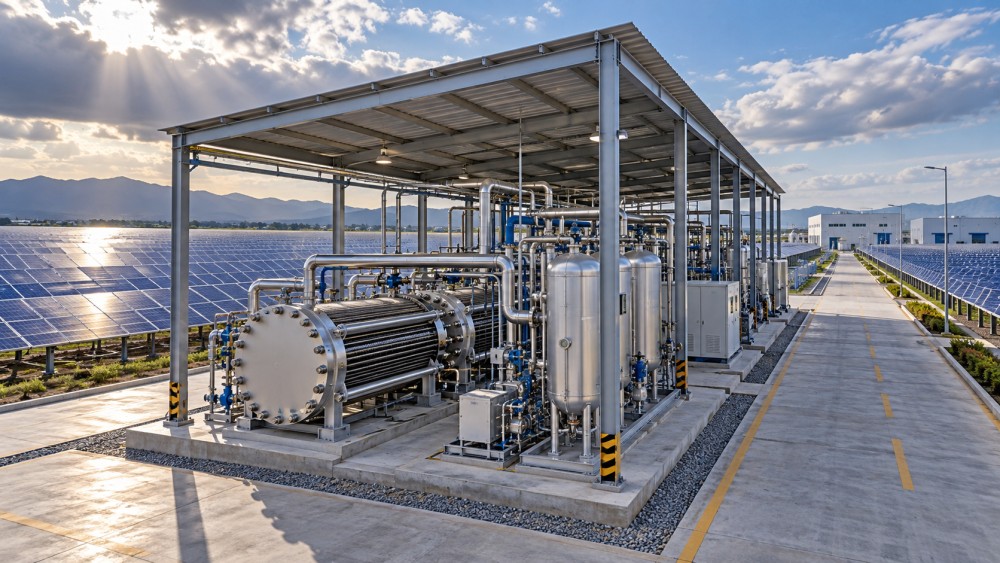
A credible sizing model should dispatch the plant against time-series solar data, applying minimum-load limits, startup conditions, conversion efficiency, and auxiliary consumption. Hourly data can support initial screening, but shorter intervals may be necessary where cloud-driven fluctuations materially affect trips or buffering requirements. Monthly averages cannot reveal those effects.
For dedicated solar, dividing generation cost by all electricity generated can understate the cost of electricity actually used for hydrogen. If substantial output is curtailed and earns no revenue, the remaining consumed electricity must support a larger share of the solar investment. Surplus electricity should receive only the export value the project can realistically obtain.
Does adding a battery make solar-powered alkaline hydrogen economical?
A battery can improve operation, but its value depends on the problem it solves. Bridging short cloud events, supporting controlled shutdowns, and keeping selected equipment energized are different duties from supplying an electrolyzer throughout the night.
Short-duration buffering may reduce trips or prevent operation near unsafe limits. Overnight production requires much more stored energy and adds battery investment, conversion losses, degradation, and replacement obligations. The hydrogen output gained must justify those costs.
Battery value should therefore be tested against alternatives such as accepting some curtailment, changing electrolyzer size, using permitted grid imports, or allowing production to stop. An operationally smoother plant is not automatically a cheaper hydrogen plant.
Hydrogen storage solves a different problem. It can separate daytime production from continuous customer consumption, but it does not keep the electrolyzer running at night. A small process buffer also should not be mistaken for storage sufficient to cover overnight demand or several low-solar days.
The comparison belongs at the delivery boundary: electricity storage, hydrogen storage, and backup supply should be evaluated against the same required delivery schedule, pressure, purity, and reliability.
Is grid-connected operation a better economic choice?
Grid access can increase utilization and reduce the need for electricity storage. It can also introduce connection charges, demand charges, network fees, and exposure to electricity prices outside solar hours. A low energy price does not establish a low delivered electricity cost.
Additional operating hours are attractive when the revenue from incremental hydrogen exceeds the incremental costs of producing it. However, a short import period that establishes a costly billing demand peak can change that calculation. Dispatch must reflect the actual tariff structure, not an annual average electricity price.
Grid imports can also affect the hydrogen’s eligibility for a contracted environmental attribute, support mechanism, or regulated market. Requirements depend on jurisdiction, applicable dates, and the specific scheme. A renewable electricity contract should not be assumed sufficient for every definition of renewable hydrogen.
The economic comparison should distinguish genuinely islanded solar operation, grid-supported operation, and operation supplied through renewable electricity contracts. These configurations have different cost structures and different evidence requirements. Combining their most favorable assumptions into one model produces a misleading result.
What does the hydrogen delivery contract change?
A customer that can accept variable hydrogen production removes a major system constraint. A customer requiring a steady flow transfers the burden of solar intermittency to storage, backup supply, or contractual flexibility.
Compression deserves particular attention. A compressor sized for peak daytime production may operate differently from one serving steady demand. Its turndown range, cycling limits, intermediate buffer capacity, and electricity consumption can affect both cost and availability.
Product specifications matter as well. Hydrogen leaving the stack is not necessarily equivalent to hydrogen meeting the buyer’s delivery requirements. Drying, purification, pressure increases, and rejected off-specification production must be included where applicable.
A low production-cost estimate has limited commercial meaning if it excludes the equipment needed to meet the sales contract. The relevant denominator is saleable hydrogen delivered at the agreed boundary, not theoretical stack output.
What evidence supports a credible investment decision?
A rated-load efficiency sheet cannot establish performance under intermittent solar. More useful evidence connects the proposed operating profile to guaranteed plant behavior:
- Variable-load performance: hydrogen output, purity, and total electricity consumption at relevant loads, with measurement boundaries stated.
- Start and standby requirements: restart time, energy consumption, purging requirements, and the conditions distinguishing hot, warm, and cold starts.
- Cycling and warranty terms: permitted starts, shutdown procedures, maintenance obligations, and exclusions related to intermittent operation.
- Operating evidence: measured results from comparable equipment under a relevant duty cycle, clearly distinguished from simulations or announced projects.
- Lifecycle assumptions: degradation, stack replacement, auxiliary maintenance, availability, and the financial consequences of missing guaranteed performance.
Operating hours alone may not adequately describe equipment exposure under repeated cycling. Warranty definitions and replacement assumptions should match the intended dispatch strategy. A model that assumes both frequent shutdowns and a lifetime established under a different duty cycle needs stronger support.
An alkaline electrolyzer is economically suited to intermittent solar when its verified flexibility, installed cost, usable solar resource, and hydrogen delivery obligations work together. The strongest case is not necessarily the site with the cheapest solar electricity. It is the configuration that converts available electricity into enough contracted, saleable hydrogen to cover the full lifecycle cost—without relying on unproven low-load performance, free storage, or unrealistic utilization.
Global Energy Questions? Contact GCES Portal
Related News
 Electrolytic HydrogenCan an Alkaline Electrolyzer Run Economically on Intermittent Solar?Can an alkaline electrolyzer run economically on intermittent solar power? Discover how utilization, storage, and system design affect hydrogen costs—and what makes a project viable.MORE+
 Electrolytic HydrogenWhat limits the minimum operating load of alkaline electrolyzers?Alkaline Electrolyzers face minimum-load limits driven by gas crossover, purity, and safety. Discover how to assess supplier claims and improve renewable-powered operation.MORE+
 Electrolytic HydrogenHow much treated water does green hydrogen production require?Green Hydrogen needs about 9 litres of water per kg at minimum—but site demand varies. Learn how treatment losses and cooling affect water budgets and smarter project planning.MORE+